
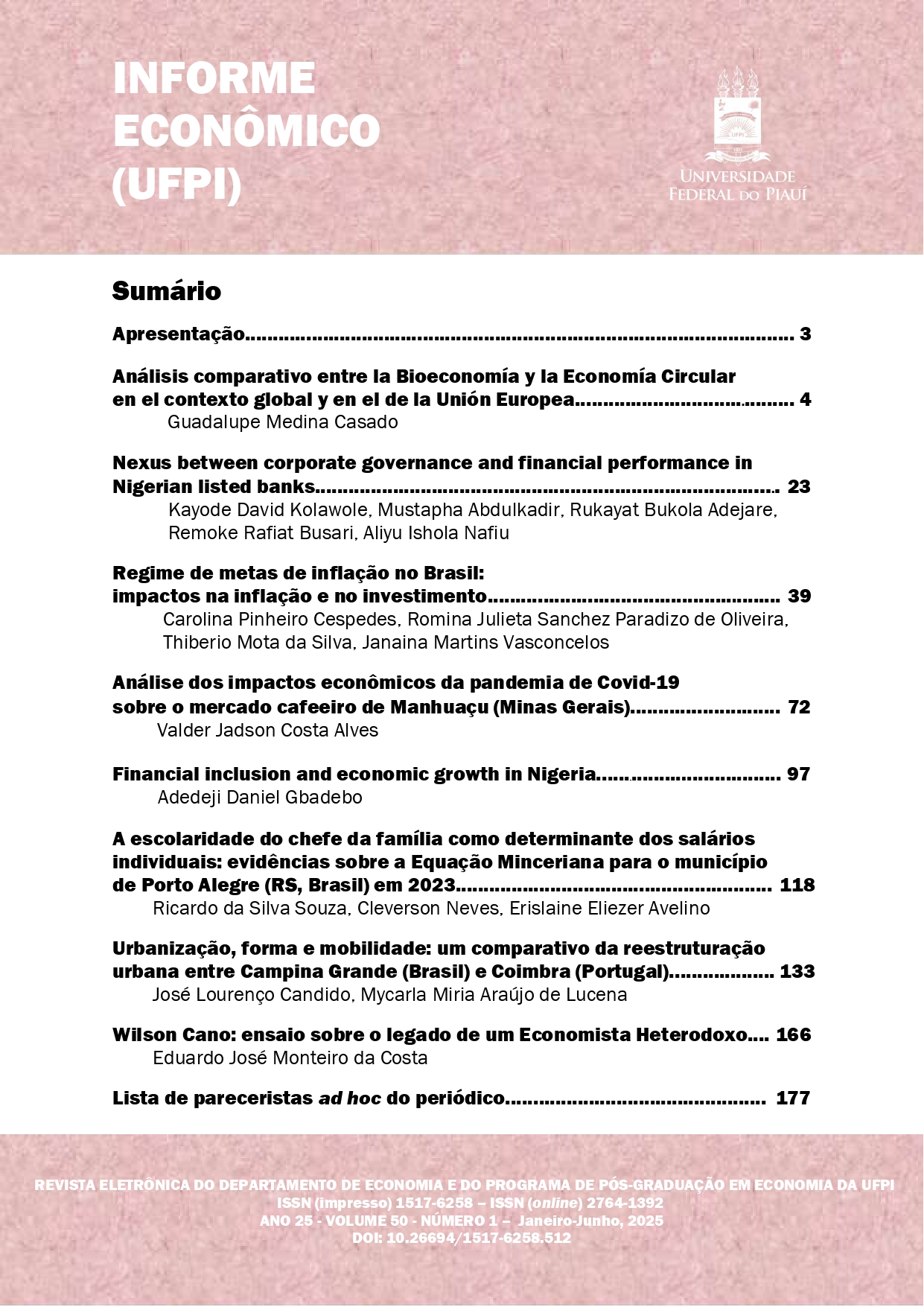
FINANCIAL INCLUSION AND ECONOMIC GROWTH IN NIGERIA
DOI:
https://doi.org/10.26694/2764-1392.7071Keywords:
Financial inclusion, Economic growth, ARDL, Mobil Banking, Agent BankingAbstract
The research study aimed at examining the impact of financial inclusion on economic growth in Nigeria. The study made use of secondary data that was sourced from the central bank statistical bulletin from 1987 to 2021. the study employed Autoregressive Distributed Lag method of analysis to estimate the data. The findings showed that, agent banking, mobile banking, financial services and money management 19.093214, 22.21476, 11.87068 and 2.784910 have significant impact on the gross domestic product. The study concludes that financial inclusion has positive impact on economic growth. The study therefore recommended that, CBN should direct its policy towards increasing the number of agent banks, especially to rural areas of the economy as millions of Nigerians living in rural areas have no access to basic banking services. CBN should collaborate with banks to ensure development of mobile banking applications that can be used on all mobile and telecommunication devices. It is also recommended that apart from directing policies to those inclusion variables that have positive effect on economic growth in Nigeria, government should establish regulatory frameworks that will ensure introduction of low cost and innovative products. Lastly, the government should engage in grass-root education on financial products through SMEs and other channels to increase financial literacy.
References
Aghion, P., Comin, D., Howitt, P., & Tecu, I. (2016). When does domestic savings matter for economic growth? IMF Economic Review, 64(3), 381-407.
Awe, A.A and Olawumi, O.R. (2012). Determinant of Income distribution in the Nigerian Economy: 1997 - 2005. International Business and Management Journal, 15 (1), 126
Babajide, A. A., Adegboye, F. B., & Omankhanlen, A. E. (2015). Financial inclusion and economic growth in Nigeria. International Journal of Economics and Financial Issues, 5(3), 629-637.
Beck, T., Demirgüç-Kunt, A., & Singer, D. (2013). Is small beautiful? Financial structure, size, and access to finance. World Development, 52, 19-33.
Calcagno, R., & Monticone, C. (2015). Financial literacy and the demand for financial advice. Journal of Banking & Finance, 50, 363-380.
Demirguc-Kunt, A., & Klapper, L. (2012). Measuring financial inclusion: The global findex database. The World Bank.
Demirgüç-Kunt, T. Beck, & Honohan, P. (2008). Finance for all Policies and Pitfalls in Expanding Access. Tilburg University, School of Economics and Management.
Dinesha, T. (2017). Financial Literacy and Inclusive Growth: Challenges and Opportunities Available at SSRN: https://ssrn.com/abstract=2985436 or http://dx.doi.org/10.2139/ssrn.2985436
Gebrehiwot, K. G., & Makina, D. (2019). Macroeconomic Determinants of Financial Inclusion: Evidence Using Dynamic Panel Data Analysis. In Extending Financial Inclusion in Africa (pp. 167-191). Academic Press.
Gourène, G. A. Z., & Mendy, P. (2017). Financial inclusion and economic growth in WAEMU: A multiscale heterogeneity panel causality approach.
Ibor, B. I., Offiong, A. I., & Mendie, E. S. (2017). Financial Inclusion and Performance of Micro, Small and Medium Scale Enterprises in Nigeria. International Journal of Research, 5(3).
Jesudasan, S., & D'souza, R. (2015). Leveraging financial inclusion for economic growth in India. ZENITH International Journal of Business Economics & Management Research, 5(6), 120-134.
Klapper, L., Lusardi, A., & Van Oudheusden, P. (2015). Financial literacy around the world. World Bank. Washington DC: World Bank.
Lyndon M.E and Peter E.A (2016). The relationship between interest rate and economics growth in Nigeria: An Error Correction Model (ECM) Approach. International Journal of Economics and Financial Research. 2(6), 127-131.
Ndebbio, J. (2004). “Financial Deepening, Economic Growth and Development: Evidence from Selected sub- Saharan African Countries” African Economic Research Consortium (AERC) Research Paper Working Paper No. 142.
Olaitan, M. A. (2015). An Overview of CBN Interventions in the Nigerian Economy (2009–Date). G215 Central Bank of Nigeria, 53(4), 39.
Saidu, T. (2015). Leadership challenges and economic development in Nigeria. Journal of Politics and Governance, 4(4), 25-35.
Saribekian, K. (2015). Bank credit risk-management for long-term loan financing: financial analysis and assessment of credit quality of the borrower. European Research, (2).
Downloads
Published
How to Cite
Issue
Section
License
Copyright (c) 2025 Informe Econômico (UFPI)

This work is licensed under a Creative Commons Attribution 4.0 International License.